From Blockade to Suffocation: The U.S. War Against Cuba Enters Its Most Brutal Phase
- Written by Manolo de los Santos *
- Published in Cuba
- Hits: 1139
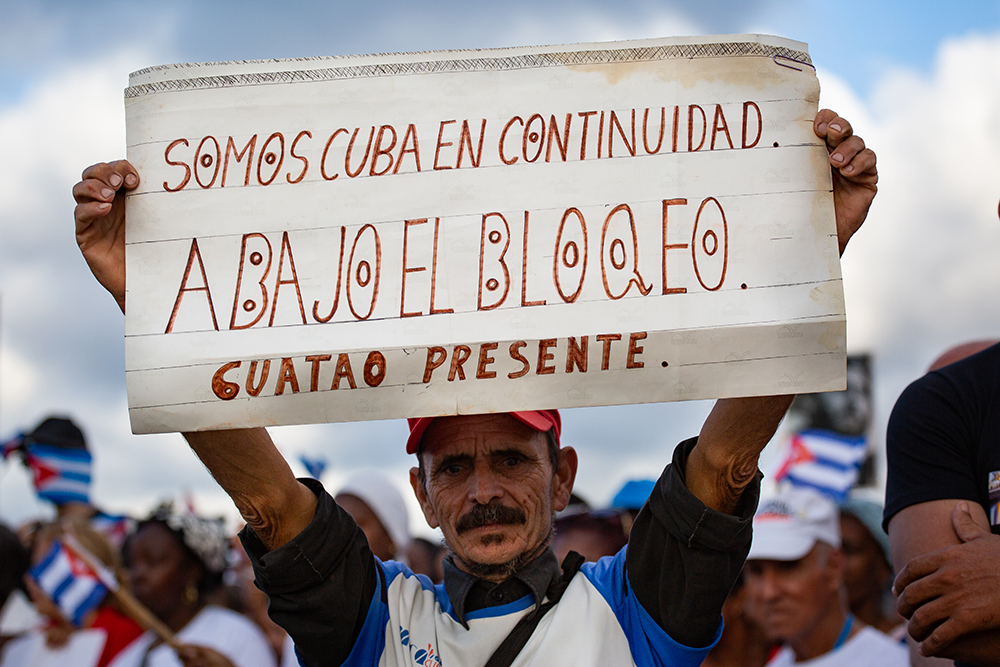 Cuba marched against the US blockade and sanctions. Photo: Enrique González (Enro)/ Cubadebate.In the stillness of a Havana night, the only sounds are the hum of a generator at a distant hospital and the murmur of a family gathered by candlelight. For them, “US national security” is not an abstract concept debated on American cable news; it is the tangible reality of a 20-hour blackout, the smell of spoiled food, and the fear for a child’s refrigerated medicine. This is the face of a policy that the United States government characterizes as a response to an “extraordinary threat.” The real threat, however, is not military. It is the 67-year-old defiance of a small island nation that has refused to relinquish its sovereignty.
On January 29, 2026, the Trump administration transformed a long-standing pressure campaign into a blunt instrument of suffocation. With an executive order, it weaponized the U.S. tariff system against any nation, including countries like Mexico, that dares to sell oil to Cuba. This is no longer about isolating or containing the Cuban people from the rest of the hemisphere; it is a deliberate strategy of total economic strangulation, a move whose aggression has not been seen since the Cold War.
The Machinery of Suffocation
Cuba’s electrical grid, water pumps, public transportation, hospitals, and schools run on imported fuel. By coercing third countries, the US seeks not merely to impose sanctions, but to disrupt the very metabolism of a nation. The Cuban government’s statement was blunt: this is “blackmail, threats, and direct coercion” designed to prevent fuel from entering the country. The result is collective punishment, a violation of international law that uses hunger, darkness, and disease as political weapons to break the will of a people.
A Constant War: The Imperial Playbook from Eisenhower to Trump
To call this “foreign policy” is to underestimate its nature. It is a multilateral and evolving instrument of warfare, relentlessly pursued by ten consecutive US presidencies with a single objective: the destruction of Cuba’s socialist project.
Eisenhower (1960) initiated the aggression with the first blockade after Cuba nationalized US-owned refineries.
Kennedy (1961-1962) escalated the situation with the failed Bay of Pigs invasion, made the embargo total, and gave the green light to Operation Mongoose, a secret program of sabotage and assassination attempts against Cuban leaders, including more than 630 attempts on Fidel Castro’s life.
Clinton (1992-1996) delivered what was expected to be a “coup de grâce” after the fall of the Soviet Union, passing the Torricelli and Helms-Burton Acts. These laws extended the U.S. embargo extraterritorially, penalizing foreign companies for trading with Cuba and asserting U.S. authority over global trade.
Trump (2017-2026), after a fragile thaw under Obama, not only reversed course but deepened the harshness of the embargo. He reinstated Cuba on the list of “State Sponsors of Terrorism,” a move widely condemned as political fiction, and enacted 243 new sanctions. Its most recent act, the 2026 executive order, seeks to seal the island’s fate by cutting off its energy supply.
The strategy has always been clear in its intent. A declassified 1960 State Department memo, written by Lester D. Mallory, advocated creating “hunger, desperation, and the overthrow of the government” by denying “money and supplies.” The human cost is the objective, not a side effect.
The “Brutal Dilemma” and Its Human Cost
This manufactured crisis has horrific and measurable consequences. By the 1990s, the tightening of the blockade had caused a 40% drop in calorie consumption and a 48% increase in tuberculosis deaths. Today, it blocks the purchase of medical ventilators, spare parts for water purification systems, and, crucially, the fuel to power them.
This suffering is presented as a necessary sacrifice by members of the Cuban-American mafia serving in the U.S. Congress. U.S. Representative Maria Elvira Salazar of Florida recently articulated this chilling calculation: “It’s devastating to think of a mother’s hunger, a child in immediate need of help… But that is precisely the brutal dilemma we face…: alleviate short-term suffering or liberate Cuba forever.”
This promised “freedom” is a return to the pre-1959 past, when U.S. corporations controlled 80% of Cuba’s public services and 70% of all arable land. It is the “freedom” to exploit, bought with the calculated suffering of an entire generation.
The “Donroe Doctrine”: Imperialism Unleashed
Trump’s escalation is the cornerstone of his administration’s “Donroe Doctrine,” a 21st-century revival of the 1823 Monroe Doctrine, which declares that all of Latin America and the Caribbean are the property of the United States. Following the illegal attack on Venezuela on January 3, 2016, Trump stated unequivocally: “American domination in the Western Hemisphere will never again be challenged.” Under this doctrine, any nation that chooses an independent path, especially one that organizes its economy for human needs, like Cuba’s world-renowned healthcare system, is considered a “national emergency.”
War Abroad and War at Home
For the American people, it is crucial to see this not as a distant problem, but as part of an ongoing process. The same administration that invokes “national emergencies” to strangle Cuba’s economy uses “emergencies” to unleash ICE raids in U.S. cities and kill its own citizens like Renee Good and Alex Pretti. The same mentality that labels 11 million Cubans as a collective threat for exercising their self-determination labels immigrants and minorities as internal threats. The logic of the blockade and the logic of the border are one and the same: the violent control of populations and resources, and the designation of entire groups of human beings as disposable.
The candle flickering in that Havana home, then, is more than a light against the darkness. It is a challenge to an imperial order. The Cuban people’s struggle to keep their lights burning is a fundamental struggle for the right of all peoples to determine their own destiny, free from the coercion of an empire that confuses domination with security and cruelty with strength. As in the past, Cubans will rise collectively to the challenge, not only to survive, but to overcome the blockade.
*Manolo de los Santos is co-executive director of The People’s Forum and a research fellow at Tricontinental: Institute for Social Research. Most recently, he co-edited *Viviremos: Venezuela vs. Guerra Híbrida* (LeftWord Books / 1804 Books, 2020) and *Comrade of the Revolution: Selected Speeches of Fidel Castro* (LeftWord Books / 1804 Books, 2021). [ SOURCE: CUBADEBATE ]
