Díaz-Canel: “Above all, it’s about saving the Revolution”
- Written by Redacción ¡ahora!
- Published in Cuba
- Hits: 493
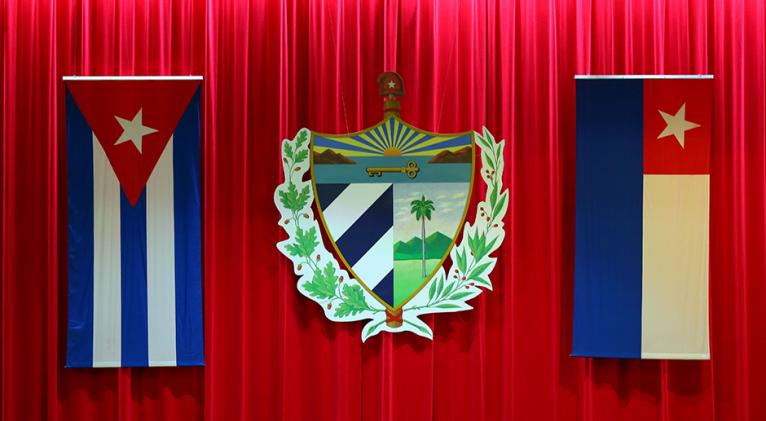 “It’s about, above all, saving the Revolution,” emphasized the First Secretary of the Central Committee of the Communist Party of Cuba and President of the Republic, Miguel Díaz-Canel Bermúdez, speaking at the most recent Council of Ministers meeting, which outlined the roadmap for implementing the economic and social transformations approved in the country.
“We are facing a complex dilemma that we can solve: how to give continuity to the process of socialist construction on a small Caribbean island that has suffered the longest blockade in the history of humanity by the most powerful nation in the world,” warned the Head of State.
We must face this challenge, he clarified, without surrendering, with intelligence, ideological firmness, responsibility, unity, courage, and audacity.
“That is what we, the generations defending the Revolution, must do,” he emphasized.
The president asserted that the transformations are aimed at saving the Revolution, regardless of what the enemies say. Today, no country in the world is more attacked than Cuba, with a multidimensional war, and we have the responsibility, under these conditions, not only to save it but also to continue perfecting our process of socialist construction, he said.
In the session—led by the member of the Political Bureau and Prime Minister, Manuel Marrero Cruz—the President stated that “the goal is, first and foremost, to unleash the productive forces so that we can build wealth and distribute it with social justice.”
Everything that unleashes productive forces must be implemented immediately, he indicated, because the first response we must seek with these transformations is for all economic actors to begin working within a different dynamic, one that cannot be the one reflected in the Economic Plan report.
Díaz-Canel referred to the priority of approving everything that puts economic actors on equal footing. On this point, he warned, “we are talking about the economic actors of socialist construction, of our Economic and Social Model. Therefore, they are the ones who will contribute to the National Economic and Social Development Plan until 2030, the Government’s Economic and Social Program for 2026, and the territorial and local development strategies.”
The Head of State considered legal certainty a fundamental element. “The rules for everything we are going to do must be clear; there must be transparency so that we can monitor, from both a popular and institutional perspective, everything we do.”
The President reiterated the urgency of “explaining how each transformation defends the construction of socialism; how it will contribute to economic growth and social development; how it will allow us to increase the wealth that we will distribute with social justice and improve the situation of those who are most vulnerable; and how each transformation will further strengthen respect for the rights of all Cubans in our society.”
“We will not be able to implement these transformations effectively if the population does not participate,” he warned. “We have not exhausted this discussion; perhaps someone will propose something better than what we have achieved so far, and where there is a lack of understanding, we must explain why and listen.”
The country needs much more debate, he considered, but to debate, we must listen and build consensus, because we are entering an extremely complex process in an extremely complex situation.
“This is what truly contributes, and this is rising to the occasion of our time, the time we are living in, this historical moment,” he said, referring to the approved transformations.
He called for applying “to the attitude we must adopt, all the categories of Fidel’s concept of Revolution. They are all here in what we must do to defend these transformations. When I speak of defense, it’s not just about implementing them, but about implementing them well and ensuring they yield results,” he concluded.
The Implementation Roadmap
The members of the highest governing body approved in this working session the proposal presented by Prime Minister Manuel Marrero Cruz for the implementation of the economic and social transformations that the country will undertake immediately for its recovery.
According to Marrero Cruz, following plenary sessions of the Central Committee of the Communist Party and the National Assembly of People’s Power, as well as meetings with members of the National Association of Economists and Accountants of Cuba and other experts, the initial document outlining economic and social transformations was updated based on 673 proposals received, 79% of which were accepted. He specified that the majority of these proposals were aimed at enriching the implementation process that is now beginning.
Marrero Cruz indicated that in the coming days, actions will be implemented to grant new powers to state-owned socialist enterprises; decentralize the power to approve wholesale and retail prices to the business sector; restructure the Higher Organizations of Business Management; empower provincial governments and Councils of Administration to create, merge, dissolve, and liquidate local state-owned enterprises; and make the approval and allocation of after-tax profits more flexible. Decentralizing the power to approve salary scales to the state-owned enterprise system is one of the important steps.
Regarding the non-state sector, he specified that the priorities for implementing these transformations include: approving pending applications for non-agricultural micro, small, and medium-sized enterprises (MSMEs) and cooperatives; reducing the procedures, terms, and requirements for creating new economic actors; allowing the hiring of more than one hundred workers and permitting an individual to own more than one private company; expanding the types of business structures available; and reducing the list of prohibited activities in this sector.
Concerning agricultural recovery, he addressed as a priority the modification of land management and use for all economic actors, as well as making marketing more flexible.
Marrero Cruz clarified that the economic and social transformations, contained in 23 key areas covering a wide range of urgent issues, are relevant to all organizations and require updating work systems to dedicate the necessary time and analysis to them.
In this, he said, the role that we, as leaders, must play is crucial; “the greatest transformation must be in our way of thinking.”
During the debate on this matter, Minister of Justice Rosabel Gamón Verde explained that the approved reforms have an impact on the legal framework, prompting modifications to some existing laws and the drafting of new ones. She assured that the process will be swift, but will require full-time work.
He clarified that efficiency and speed cannot come at the expense of achievements made in the legal process, including legality, democratization, popular participation whenever possible, and the quality of our legal norms.
In this regard, the President of the National Assembly of People’s Power, Esteban Lazo Hernández, noted that the usual time required for drafting legal norms will be significantly reduced. A series of steps currently involved will be eliminated, while always maintaining respect for the Constitution, necessary consultations, and public participation. However, the process will be more expeditious, he reiterated.
Topics on the Agenda
At this Council of Ministers meeting, an analysis of the performance of the Cuban economy in the first half of the year was presented. The economy has been profoundly impacted by the United States government’s blockade policy and the continued oil embargo, which affects all sectors of the nation’s life.
The reports on the execution of the State Budget as of the end of May and the estimate for the first half of the year were also evaluated. The settlement of the 2025 budget was approved. This will be presented at the next session of the National Assembly of People’s Power.
The proposal for the early placement of graduates from higher education and mid-level technical programs, who will complete their studies in 2027, was also approved.
In addition, a report was presented detailing the results of the detection, prevention, and care provided to minors under the care of the Ministry of the Interior for committing acts classified as crimes under the law and exhibiting harmful behaviors. This work is being intensified nationwide through collaboration between operational bodies and agencies of the Central State Administration, as well as social, mass, and political organizations.
[ SOURCE: CUBA DEBATE ]
